




323: Crannog 🏝🛖
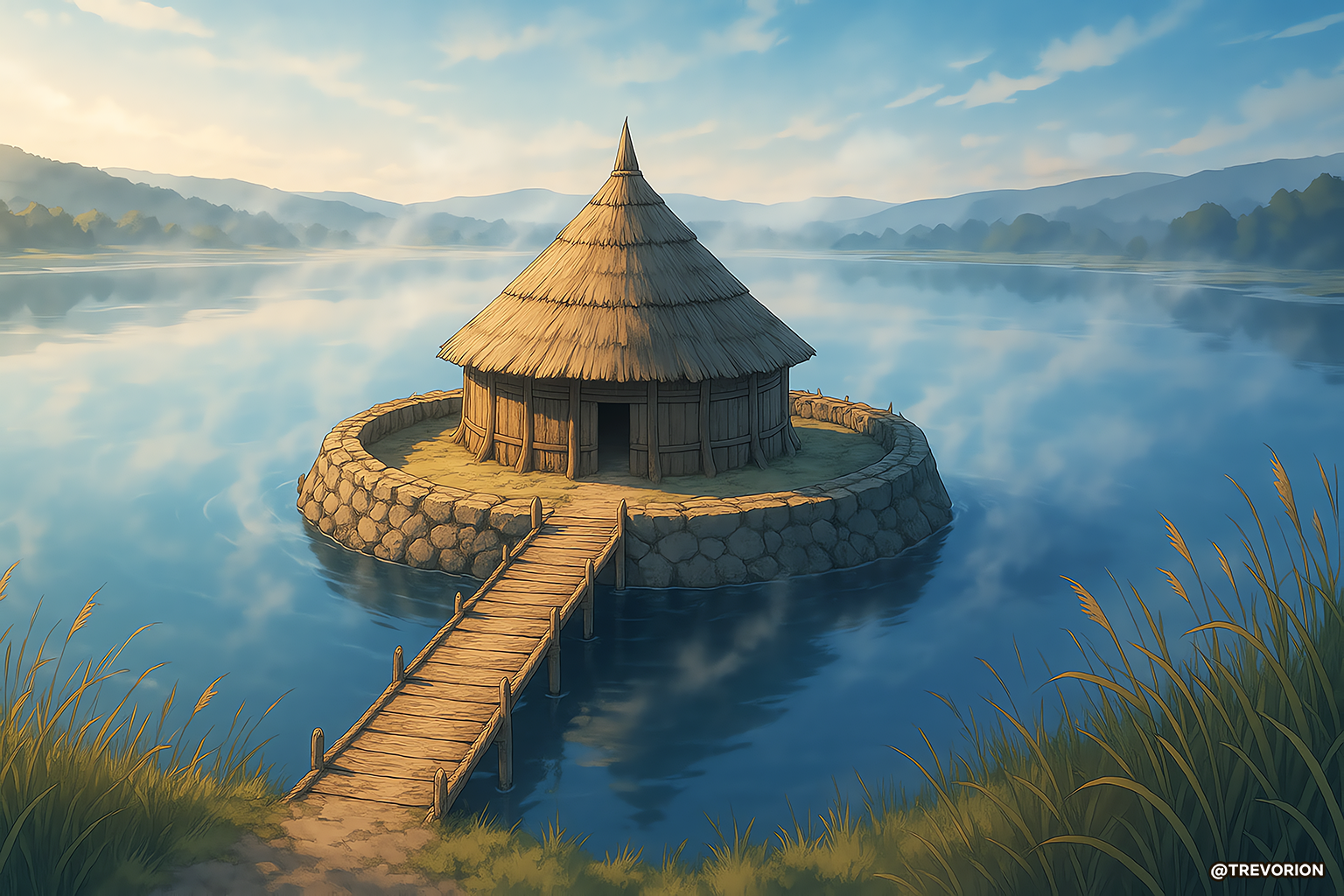
Daily Image created using ChatGPT (Anime AI Art)
🛖 The Keeper
Cormac rose early, as usual, before the mist lifted and disclosed the mainland. The lake was still, the crannog a ring of silence in the blue with the occasional sounds of distant birds. Reeds whispered against the dun, and the wooden walkway creaked under his boots as he stepped out from the thatched hut.
Each morning, he checked the roof, the wall bindings, and the wooden causeway, swept the walkway, and gathered reeds for patching. The crannog had stood for centuries, built by his ancestors on a natural islet, as a haven from the wilderness. And now it was his alone.
It was passed down through several generations of the McCarthy family to his grandfather. His father had grown up here too but when he moved out for studies, he raised a family in the city and returned only for vacation. To Cormac, the ancient dwelling was beyond his grandparents’ abode; it was a magical place.
Over the years, a lot had changed. In the distance, the forest had thinned out with both urban and agricultural developments. Tourists came in summer, snapping photos from drones and kayaks. They called it “the Iron Age little fort,” though Cormac knew its bones were older.
His family had preserved old pottery, copper and bronze tools, quern stones, and ancient scraps of 1/2 twill. The coarse weave still held the scent of peat. He even had several lignite jewellery pieces and bronze pins, most of which were inherited, some found beneath the floorboards or in the silt. It all had immense archaeological value.
Cormac had turned his back on his white collar career, leaving his father’s business in his sister’s hands, and had settled permanently here. He did not regret trading steady income and the rhythm of the city for the quiet pulse of the lake. His relatives questioned his sacrifice, his lack of ambition, his loneliness, and his sanity.
The truth was the city had exhausted him. The constant performance, the calculated moves, the hunger that never quieted. In contrast, his sister thrived in it. He relished the silence that bound him to the lake instead. He rarely spoke to anyone and visited town only about once a week for supplies, nodding to the shopkeeper and seldom interacting with other residents.
In the cold season, he would enjoy the loneliness, diving into books and media, sharing moments with the lake, which replied through mist and wind, through the soft slap of water against timber. In the summer, he recruited a small crew to hold crannog reenactments for tourists.
One morning, he found a reed bundle tied with red thread at the edge of the walkway. A gift. He looked toward the shore but saw no one. The following week, a child’s drawing appeared with crayon lines of the crannog, the hut, and the lake. He placed it inside a big old cedar box.
Years passed. The drawings kept coming every season. The art portrayed an increase in skill, curves executed with a steady hand, richer colours, and intricate detail. He never met the artist, but he felt the connection. The crannog was no longer just his. He now shared it with someone who remembered.
Old Cormac stood on the walkway, as always, watching the mist curl upward as the sun dipped low and the lake turned to silver. The reeds bent with the breeze, carrying the smell of damp timber. The crannog stood whole and silent, its ring reflected in the water. The cedar box kept the stack of drawings, sealed and dry, some faded but all vivid.